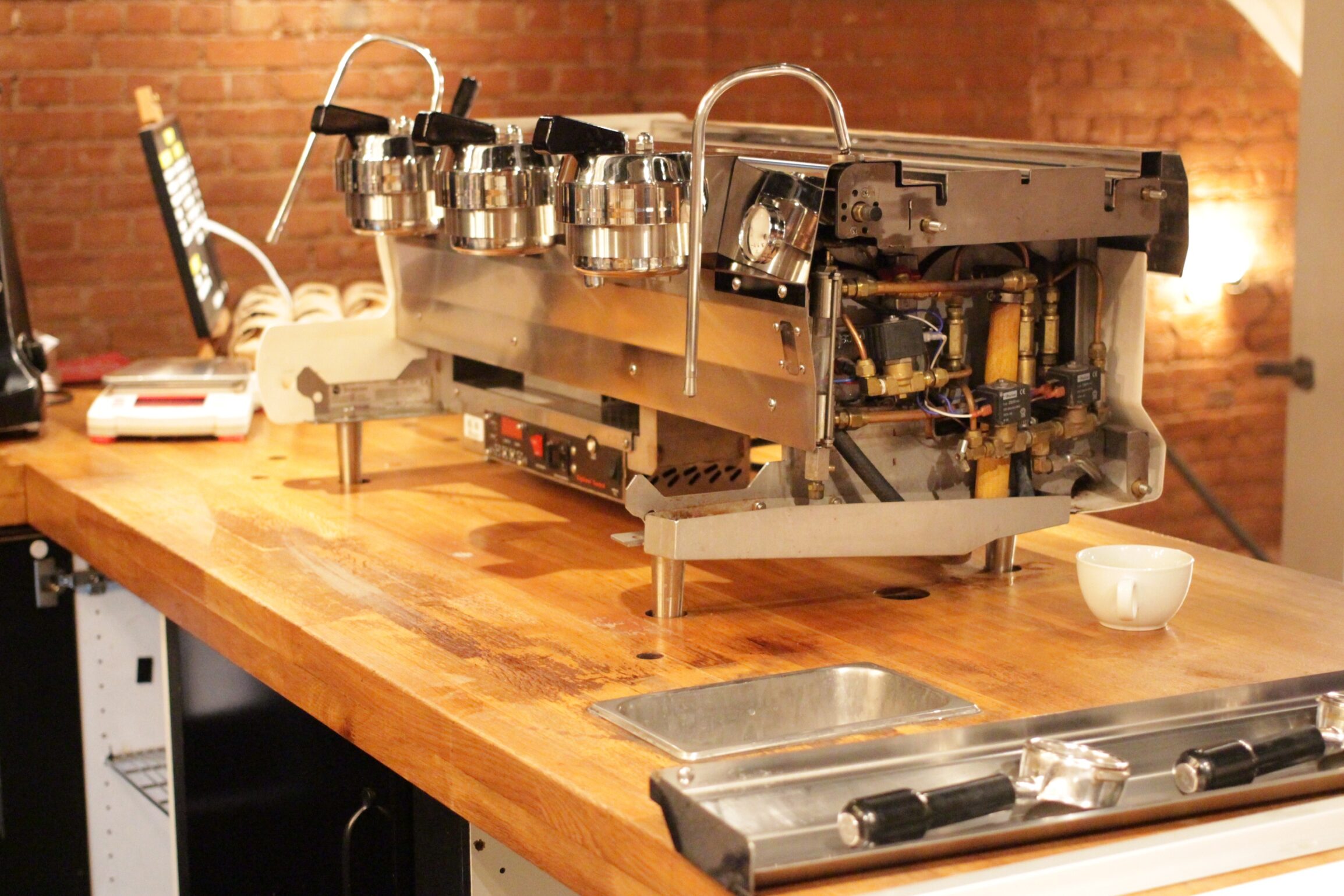
The specialty coffee world often focuses on exotic origins, complex roasting profiles, and the sheer mechanical beauty of a high-end espresso machine, like a gleaming La Marzocco Linea PB or Strada. We rightly celebrate the dual boilers, saturated groups, and PID controllers that promise unmatched thermal stability.
Yet, a fundamental truth often remains obscured: simply investing in a high-end machine is not enough. The difference between an average café and a world-class coffee bar lies not in the purchase, but in the meticulous technical execution of the system—the unseen variables of configuration, power, installation, and daily calibration. This technical blog explores why these factors are the true foundation of exceptional espresso.
1. The Criticality of Precise Installation: Beyond Plug-and-Play
A La Marzocco is a complex piece of equipment, not a domestic appliance. Its installation demands technical expertise that treats it as an industrial tool for precision extraction.
A. Water Management: The Single Most Important Ingredient
The Dual Boiler system on a La Marzocco offers extraordinary temperature stability, but this is immediately undermined by poor water quality.
- Limescale: The Silent Killer: Hard water minerals build up inside the boilers and pipes. This causes limescale, which reduces the efficiency of the heating elements (increasing energy costs) and, critically, introduces temperature fluctuations that sabotage the PID controller’s efforts at precision.
- Optimal TDS and pH: Proper installation requires a multi-stage water filtration system (often with reverse osmosis and re-mineralization) to achieve the manufacturer-specified Total Dissolved Solids (TDS) and pH levels. This ensures the water is chemically ideal for both flavour extraction and machine longevity.
B. The Zero-Tolerance Level: Bench Stability
The physical placement must ensure the machine is perfectly level and on a sturdy, heat-resistant surface. Even slight unevenness can affect the distribution of water in the brew groups, leading to subtle inconsistencies in pressure and flow—a phenomenon known to baristas as “channeling.”
2. Refined Power Supply Management: The Engine’s Fuel
The high power consumption of a multi-boiler machine is necessary for rapid recovery and continuous steaming, but it is highly sensitive to electrical instability.
A. Stable Voltage for Thermal Stability
La Marzocco machines utilize PID (Proportional-Integral-Derivative) controllers to maintain brew water temperature within a fraction of a degree. This algorithm relies on a stable energy supply to precisely modulate the heating elements.
- The Technical Risk: Voltage drops (brownouts) or surges can disrupt the delicate balance of the PID controller. Even a momentary dip can cause the heating element to draw less power than anticipated, leading to a subtle drop in boiler temperature, resulting in an under-extracted, sour shot.
- The Solution: Professional installation often mandates a dedicated circuit with the correct amperage (often three-phase power for larger models) and, in environments with unstable grid power, a high-quality Uninterruptible Power Supply (UPS) or surge protector capable of smoothing out electrical fluctuations. A refined power supply ensures the machine’s thermal stability features can operate to their full potential.
3. The Calibrated System: Roasting, Grind, and Extraction
The technical supremacy of the espresso machine must be matched by the precision of the grinder and the skill of the human element.
A. Grinder Precision: The Critical Interface
The grind size setting on the commercial grinder is the barista’s most powerful tool. The precision of a high-end machine is immediately wasted if the grinder cannot deliver a uniform, consistent particle size.
- Extraction Physics: Espresso extraction relies on creating the perfect resistance (the ‘puck’) to the 9-bar pressure applied by the La Marzocco. The correct resistance allows the water to pass through in a targeted time-frame (e.g., 25-30 seconds) for optimal extraction of desirable compounds.
- The Daily Dial-In: Because green coffee beans are an agricultural product, their density and moisture content change subtly with the season, humidity, and their time post-roasting. The highly volatile nature of freshly roasted coffee demands that the grinder’s burrs be adjusted several times a day—the “dial-in”—to maintain the prescribed flow rate.
B. Barista Academy: Bridging Tech and Taste
No amount of advanced engineering can replace the judgment of a skilled professional. This is the role of the Barista Academy—to translate technical specifications into sensory reality.
- The Recipe: The barista must precisely configure the extraction recipe (e.g., a $1:2$ brew ratio, meaning 18 grams of ground coffee yields 36 grams of espresso in 28 seconds) and use tools like precision scales to ensure repeatable results, shot after shot.
- Machine-Roast Synergy: Training is essential to understand how different roasting levels require different brew temperatures (easily adjusted on the La Marzocco’s PID) and grind settings for maximum flavour expression.
Conclusion: The Pursuit of Excellence
Investing in a La Marzocco is an investment in a promise of excellence. But that promise is only unlocked when the entire technical environment is perfected. It is the sophisticated integration of:
- Precise Installation (Water & Structural Integrity).
- Refined Power Supply Management (Voltage Stability for PID).
- Calibrated Grinder (Particle Consistency for Resistance).
- Trained Barista (The Human Calibrator and Quality Control).
The great cup of coffee is an equation where the machine is just the constant. The variables—power, water, and grind—must be perfectly managed to achieve the consistent, transcendent espresso that defines specialty coffee.